
Marketing Cloud Email Specialist Practice Quizzes
Thank you for taking the next step in your Marketing Cloud journey.
Your commitment to strengthening your expertise makes a difference — and these practice quizzes are designed to help you sharpen your skills with confidence and clarity.
The Salesforce® Marketing Cloud Email Specialist certification validates a professional’s ability to design, build, send, and analyze email campaigns using Marketing Cloud. It is designed for marketers and marketing operations professionals who want to demonstrate hands-on proficiency with subscriber data, content creation, automation tools, and performance reporting — all within a real-world marketing context.
This certification is not just about technical knowledge. It measures your ability to interpret business scenarios, apply best practices, and select the right tools to solve marketing challenges effectively and efficiently. From foundational email strategy and deliverability considerations to advanced automation workflows and performance insights, the exam reflects the full lifecycle of modern email marketing execution.
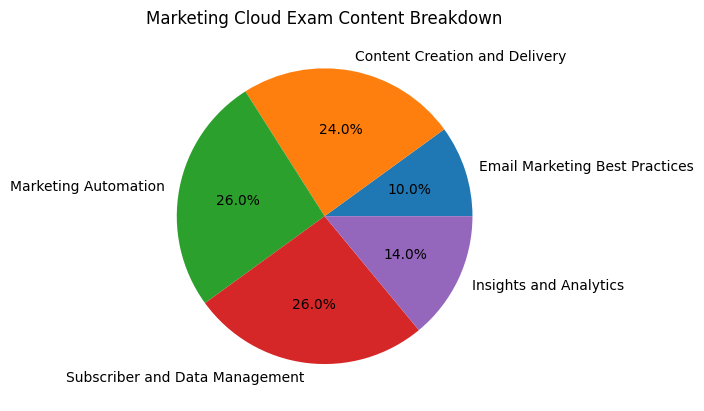
This chart illustrates how the exam content is weighted across key competency areas, giving you a clear view of where to focus your preparation efforts.
Email Marketing Best Practices (10%)
This section focuses on foundational strategy and execution principles that drive effective email programs. Learners must evaluate customer scenarios to design high-performing emails, balancing creative structure with technical considerations like deliverability. It also emphasizes subscriber acquisition and retention strategies — ensuring marketers build compliant, engaged audiences while minimizing risk. Though weighted at 10%, this domain represents the strategic discipline that underpins everything else. (25 Questions)

Content Creation and Delivery (24%)
Content Creation and Delivery tests the ability to move from strategy to execution. Candidates must select appropriate Marketing Cloud tools (Email Studio, Content Builder, etc.) based on sending requirements, customize messaging to meet business needs, configure send settings properly, and manage campaign content efficiently. This area blends creative, technical, and operational skills — making it one of the most hands-on components of the exam.

Marketing Automation (26%)
Marketing Automation carries significant weight because it represents scalable execution. Candidates must determine the correct automation solution for a scenario and build it using either Automation Studio or Journey Builder. This includes structuring data-driven workflows, event-triggered journeys, and scheduled processes that operate reliably in the background. Mastery here reflects the ability to move beyond single sends into orchestrated lifecycle marketing.

Subscriber and Data Management (26%)
Data is the engine of Marketing Cloud. This section tests the ability to design and configure Data Extensions, import and structure subscriber data correctly, apply segmentation tools effectively, and troubleshoot discrepancies related to subscriber preferences. Because personalization and automation rely entirely on clean data architecture, this domain carries equal weight to Marketing Automation — reinforcing that execution is only as strong as the data model behind it.

Insights and Analytics (14%)
Insights and Analytics measures the ability to interpret performance and optimize future campaigns. Candidates must understand email metrics (delivery, open, click, conversion, etc.), analyze campaign results, configure reporting, and recommend Einstein tools that enhance performance analysis. While smaller in percentage, this section reflects strategic maturity — ensuring marketers can measure impact and continuously improve.
